THOUGHT LEADERSHIP
The Hidden Balance Sheet Cost of CECL and IFRS 9
·
5 min read
Executive Summary
CECL (US GAAP) and IFRS 9 are often treated as accounting standards, but for insurers they increasingly behave like a balance sheet and capital discipline. By requiring earlier, forward-looking recognition of expected losses across premium receivables, broker balances and recoverables, both frameworks can drive a material reduction in reported assets and equity, even when counterparties ultimately pay. In practice, provisions are highly sensitive to ageing, disputes and information quality, meaning even current receivables can attract allowances and older or poorly understood balances are penalised heavily.
Under CECL and IFRS 9, elevated allowances are often driven less by true credit deterioration than by operational debt hygiene, making the most effective mitigation the systematic reduction and evidencing of aged debt through event-driven ageing, robust cash matching, transparent dispute tracking, and purpose-built premium payment operations infrastructure. Diesta provides this infrastructure by delivering a reconciled premium-and-cash sub-ledger and workflow controls that reduce aged debt, improve evidence quality, and stabilise expected credit loss outcomes.
Introduction
CECL (Current Expected Credit Loss) and IFRS 9 are often framed as accounting standards. For insurers they behave like balance sheet and capital disciplines, because they force earlier, more conservative recognition of expected losses across premium receivables, broker balances, and reinsurance recoverables.1
While the intent is prudence, the practical outcome is frequently a material reduction in reported assets and equity that is not primarily driven by true counterparty default. Instead, it is driven by how well, or how poorly, organisations can evidence that receivables are understood, actively managed, and genuinely recoverable. In many cases, insurers take the accounting hit not because the money is gone, but because the operational reality is opaque.
Both CECL and IFRS 9 require expected credit loss allowances that are forward-looking, sensitive to ageing, influenced by counterparty behaviour, grounded in historical loss and dispute patterns, and adjusted for macroeconomic outlook.1 This means even current receivables can attract provisions, older balances are penalised heavily regardless of eventual collection and disputed or poorly understood items can become fully provisioned.2 The allowances flow through the P&L and retained earnings, creating a “haircut” to equity that becomes persistent unless receivables quality and evidence improve.3
The result, a quiet, compounding balance sheet cost that can impact valuation, cost of capital, and executive confidence in reported numbers.
Financial Impact
In theory, CECL and IFRS 9 measure credit risk. In practice, they often end up measuring operational debt hygiene.
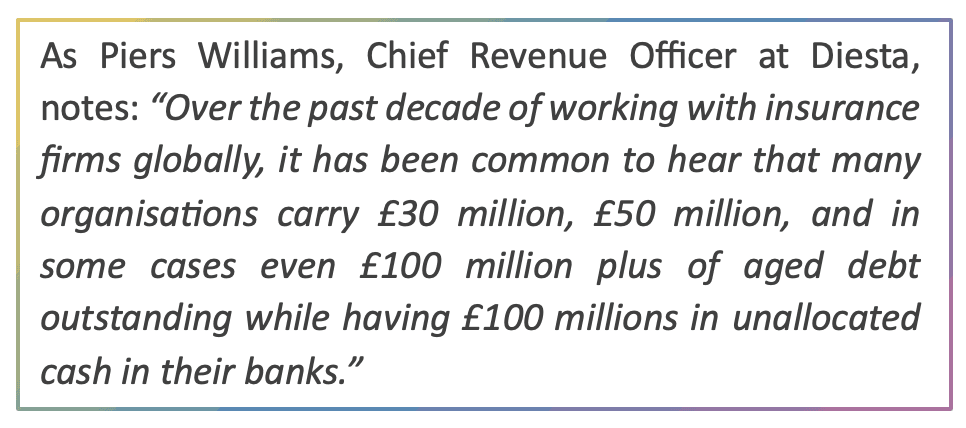
Many insurers carry aged balances not because counterparties have defaulted, but because day-to-day mechanics break down: cash remains unallocated or misallocated; client statements and bordereaux are late, incomplete, or inconsistent; settlement payments are delayed by downstream bottlenecks; disputes sit in emails and spreadsheets; and sub-ledgers are fragmented across systems. The debt becomes “old” because it is operationally unresolved.
Under CECL and IFRS 9, that operational friction becomes financial impact. Apparent loss rates rise in ageing buckets, provision matrices deteriorate, lifetime expected credit loss allowances increase, assets are written down, and retained earnings erode.4 What begins as messy data and slow resolution becomes a capital-consuming problem.
This is why the most effective way to reduce CECL and IFRS 9 impact is not to “optimise the model” in isolation, but to reduce aged debt at the root. That requires event-driven granular ageing, clear distinction between genuinely overdue vs operationally unresolved balances, robust cash matching to premium and recoverables, transparent dispute and settlement tracking, and granular historical loss data by counterparty and age bucket. In short, it requires purpose-built premium and payment operations infrastructure.
When aged debt reduces, and when the organisation can evidence why balances are outstanding, expected credit losses reduce with it.
Below is a simplified illustration showing how the same £10m of premium receivables can translate into a large reduction purely based on ageing-driven loss rates. The rates are illustrative, but the mechanism reflects how these expected credit loss methodologies behave in practice: as balances migrate into older buckets, assumed loss severity rises rapidly.5
CECL Example (Illustrative)
Age bucket | Balance | Default rate | CECL allowance |
0–30 days | £1,000,000 | 2% | £20,000 |
30–60 days | £2,000,000 | 5% | £100,000 |
60–90 days | £2,000,000 | 12% | £240,000 |
90+ days | £5,000,000 | 35% | £1,750,000 |
Total CECL reduction | £2,110,000 |
As a result, a £10.0m gross receivables balance is reduced by £2.10m under CECL, leaving only £7.90m recognised as net receivables on the balance sheet.
IFRS 9 Example (Illustrative)
Age bucket | Balance | Default rate | CECL allowance |
0–30 days | £1,000,000 | 1.5% | £15,000 |
30–60 days | £2,000,000 | 4% | £80,000 |
60–90 days | £2,000,000 | 10% | £200,000 |
90+ days | £5,000,000 | 30% | £1,500,000 |
Total IFRS 9 reduction | £1,795,000 |
Similarly to CECL as a result of the IFRS 9 framework, a £10.0m gross receivables balance is reduced by £1.80m, leaving only £8.20m recognised as net receivables on the balance sheet.
This reduction flows through to retained earnings, lowering reported equity and reducing the capital available to the business. To prevent this reducing aged debt is one of the most effective ways insurers can protect their balance sheet under CECL.
Hence, the message under both frameworks is that aged debt is not just “a collections problem”, it becomes a measurable and immediate balance sheet haircut.
The examples above are simplified and focus on ageing. In real insurance environments the impact is often more severe because models incorporate additional drivers: counterparty behaviour, historical disputes, write-offs, settlement dynamics, macroeconomic overlays, and governance-driven conservatism. Each factor can further increase allowances held against premium receivables.6
In the examples shown, roughly 20% of outstanding premium is written down from an accounting perspective on day one. That is not a marginal adjustment, it is a material reduction in reported assets and equity that can persist if aged debt remains structurally high or poorly evidenced.
The Solution
Diesta addresses CECL and IFRS 9 where it matters most: upstream in the operating model, not downstream in the impairment calculation.
By providing a clean, reconciled premium-and-cash sub-ledger and the workflow infrastructure around it, Diesta enables insurers and carriers to reduce the operational conditions that create aged debt and provisioning pressure.
In practice, this means firms can:
reduce aged debt and unallocated cash through structured matching and resolution workflows
improve the quality and timeliness of ageing (real-time, event-driven, audit-ready)
reduce disputed balances through clearer lineage and evidence trails
move from reactive clean-up to proactive receivables management
increase operational efficiency through automation of manual reconciliations and statement handling
reduce balance sheet volatility and strengthen audit/regulatory confidence
CECL and IFRS 9 do not reward complexity. They reward clarity, control, and data quality.
CECL and IFRS 9 are not temporary challenges. They are permanent features of the insurance finance landscape, one that will continue to mature and tighten as financial regulation and audit expectations evolve.6
In a soft market, can insurers continue to accept a structural haircut to balance sheet value due to legacy receivables operations? Or are premium payment operations one of the clearest opportunities to protect equity, improve cash conversion, and increase financial returns?
Firms that treat CECL and IFRS 9 as purely regulatory exercises will continue to absorb unnecessary impacts. Firms that address the operational drivers of aged debt can materially reduce exposure and unlock
Speak to Diesta
If CECL or IFRS 9 provisions are placing sustained pressure on your balance sheet, it may be time to look beyond the impairment model and assess the operating system underneath it.
Diesta works with insurance finance and operations teams to reduce aged debt, improve cash visibility, and strengthen the data foundations that CECL and IFRS 9 rely on, so receivables are not only collectible, but demonstrably recoverable.
If you’d like, we can share a short diagnostic framework to quantify how much of your allowance is driven by true credit risk vs operational debt hygiene and what reduction is achievable through modernised premium and cash workflows. Reach out at hello@diesta.co.uk or via www.diesta.co.uk