THOUGHT LEADERSHIP
The Cost of Waiting for Insurance Payments
·
5 min read
Introduction
Insurance is commonly described as a business of underwriting, distribution and capital. Far less attention is paid to the complex payment infrastructure underpinning this marketplace. That is a mistake. In commercial insurance, value does not move directly from buyer to seller in a single transaction. It passes through a fiduciary system in which receivables, payables and cash coexist for extended periods across various entities. The efficiency of that system matters because it determines how quickly revenue turns into working capital, how soon it can be reinvested, and how much value is lost in transit.
This paper examines that system through the four largest intermediaries in the market: Aon, Marsh, WTW and Gallagher. The analysis draws on quarterly SEC filings for these U.S.-registered brokerage groups from 2018 and 2025. This reporting provides a more detailed and comparable view of fiduciary balances than is typically available elsewhere. A key term in this paper is fiduciary funds, which WTW defines as “restricted cash held for unremitted premiums, claims and certain benefit funds, typically in regulated accounts designed to preserve capital and liquidity.” Practically, this asset class combines income-generating cash and a regulatory duty to safeguard and forward within agreed timelines.
The purpose of this paper is not to describe every nuance of insurance payment flows, but to draw attention to the infrastructure problem underneath them. The question is not whether insurance firms are sufficiently resourced or sophisticated to deal with the issue; they clearly are. The question is how those resources can be used effectively to create a new infrastructure that converts value quickly and improves the service to the original insured. To achieve this, money must move faster between distribution and capacity partners within the insurance industry, minimising drag on fiduciary assets, income and losses. At present, it does not. This is the cost of waiting.
This whitepaper is structured in three sections looking at the state of fiduciary receivables, income and write offs. Ultimately, it argues that the current payment infrastructure model is no longer sustainable and opens a wider discussion on how the industry can improve financial performance and its value to the end customers.
The Weakness
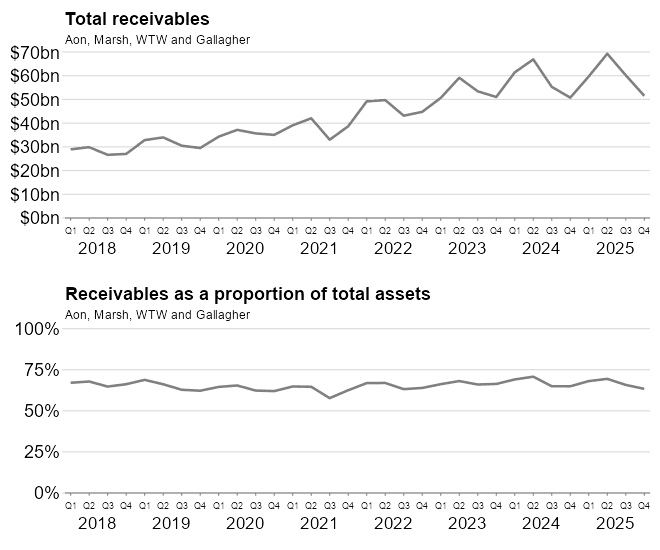
The weakness of insurance payments is best understood through what has not changed. Over the last eight years, fiduciary assets have nearly doubled, while receivables ratios have remained stubbornly high. In 2018, receivables accounted for 66.2% of aggregate fiduciary assets across Aon, Marsh, WTW and Gallagher. Between then and 2025, the ratio has fluctuated within the same range and, as at Q4 2025, stands at 63.4%. Within that movement, there is no observable trend to support any claim of structural repair. Brokers’ balance sheets remain defined primarily by receivables, not cash.
The absolute numbers help illustrate just how significant that outstanding position is. At the end of 2018, the four firms held $40.8bn of fiduciary assets, made up of $27.0bn in receivables and $13.8bn in cash. By the end of 2025, their total assets had doubled to $81.3bn, and receivables rose to $51.5bn. This means there these firms have now over $10bn more money outstanding than they held in total fiduciary assets at the end of 2018. As these businesses have grown their revenue over the past years, so too has the scale of capital tied up in receivables, pushing outstanding balances to a record high.
At the level of individual firms, some stand out for a clear deterioration over the analysed period, while others were able to make modest improvements. Most, however, remained broadly consistent across the period analysed. That suggests firm-level practices can influence outcomes, but the persistence of the problem across the segment and analysed period points to a structural industry dynamic.
Overall, insurance payments still fall well short of functioning as a fast settlement system. Across the four firms analysed, the time between insurance sale and payment receipt averaged 7.5 months - long enough for premiums to behave less like payments in transit and more like locked working capital. As detailed information is unavailable, it is difficult to determine whether this money remained outstanding from the original insureds or is stuck within the insurance chain. For an industry built on cash management, that delay and lack of transparency is a material weakness. With payments taking multiple months to reach brokers, full settlement across the industry is a matter of years. This has a significant impact on the industry’s core purpose: the safeguarding and payment of claims. Slow payments within insurance mean reduced value delivery by the industry as a whole.
Fiduciary Income
For years, slow settlement could be dismissed as a tolerable inefficiency. That is no longer the case. While receivables have grown sharply, the cost of carrying them has risen in step with higher interest rates. Both factors together compound to a significant negative impact for the industry.
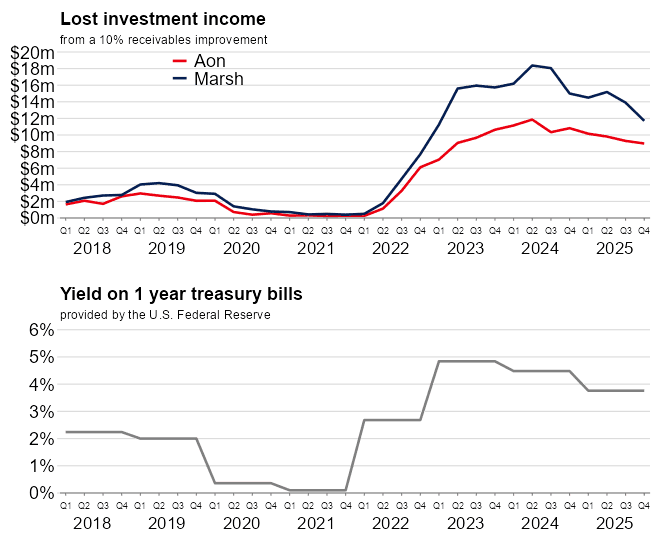
Commercial insurance is no longer operating in a near-zero-rate environment which means delay now carries a visible financial penalty. The Federal Reserve’s policy rate moved from effectively zero in 2021 to 5.4% at the end of 2023, before easing to 3.6% at the end of 2025. To measure the opportunity cost of higher interest rates, this paper estimates how much additional fiduciary income could have been earned by brokers if outstanding funds had been reduced by a conservative 10%. This approach has been chosen in line with results observed by market participants adopting specialised payment technology.
Analysing the data from Aon and Marsh reveals that the forgone investment income against this small improvement is substantial. For Aon, estimated lost fiduciary income raised from $8m p.a. 2018 to $44m in 2024 before easing to $38m p.a. in 2025. Marsh’s lost fiduciary income was even larger rising from $10m to $68m p.a. before easing to $55m p.a. over the same period.
Over the period, the two entities combined missed out on $382m of additional investment income. Beyond lost fiduciary income alone the opportunity cost across the business stretches even further. For example, working capital left tied up in the fiduciary system, cannot be used for the growth of the organisation, which would typically generate returns at a meaningfully higher rate. Given the scale of lost investment income and trapped growth capital, even large structural projects look small by comparison.
The implication of the analysis is clear. Faster collection does not only bolster the balance sheet but in the current environment is a direct source of additional income. Better payment infrastructure and tighter control over receivables can deliver a meaningful uplift in income, even against small improvements. Across the wider industry, the stock of receivables is far larger than for the firms analysed here. Commercial insurers are particularly exposed, with larger sums outstanding for longer periods, creating a more significant loss of investment income. As long as interest rates remain elevated, fragmented cash management practices will continue to hold back both firms and the industry. This leaves insurance structurally disadvantaged against other sectors that deploy capital faster and more efficiently.
Write-Offs
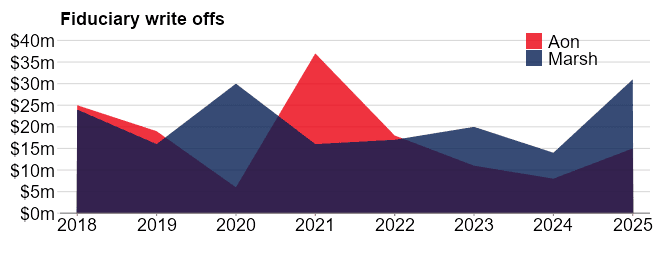
If lost fiduciary income captures the cost of cash arriving late, write-offs capture the cost of cash not arriving at all. They are the harsher reality of the same structural weakness. At that point, delay is no longer just a lost opportunity cost, it becomes value destruction. Given the size of insurance, the sums involved are far from trivial. Across Aon and Marsh alone, annual fiduciary write-offs repeatedly ran into the tens of millions of dollars per year.
The pattern over the analysed period is uneven and not reassuring. Aon’s annual fiduciary write-offs rose from $25m in 2018 to $37m in 2021, before easing to $15m in 2025. Marsh followed a different trajectory, writing off $24m in 2018 and $16m in 2021, before rising sharply to $31m in 2025. This behaviour points to a sporadic process, likely driven by individual firm practices and accounting optimisations. Looking beyond the annual trends across the eight-year period analysed, Aon and Marsh recorded a combined $307m of fiduciary write-offs. That equates to an average write-off of just under $20m per year per firm, relating to gains that had previously been recognised but have now been permanently reversed. The impact on shareholders and insurance partners is not disclosed.
When plotting the write offs as percentage of the total fiduciary receivable pool, an improvement over the years can be found. Aon’s write-offs as a proportion of fiduciary receivables fell from 0.40% in 2018 to 0.08% in 2024, before rising to 0.14% in 2025. Marsh followed a similar path and improved from around 0.31% in 2018 to 0.09% in 2024, before deteriorating to 0.21% in 2025. The overall trend suggests operational improvements across those two firms might take effect and show value. At the same time, the large build-up in receivables means these improvements have done little to reduce absolute write-offs.
The improvement in the write-off ratio offers a beacon of light in an otherwise bleak picture of limited progress. It remains to be seen, however, whether the industry has made any genuine structural improvement in managing write-offs, or whether the observed trends simply reflect seasonality. What is clear is that write-offs continue to destroy significant value on a recurring basis. Because these losses directly reverse previously reported profits, they deserve far greater scrutiny from both management teams and shareholders.
Conclusion
This paper argues that insurance payments function as the infrastructure converting booked value into working capital and income. Today, that infrastructure has a serious velocity problem, eroding value at an industrial scale. Across the eight-year period analysed, there is limited evidence of structural improvement that the market has embarked on. If anything, the position has worsened, as higher interest rates and larger outstanding positions have made the cost of waiting skyrocket.
The problem of slow insurance payments is centuries old and rooted in the very origins of the industry. But its age is no excuse for its acceptance. At a time when technology and payment infrastructure have advanced materially, continuing to wait months for payments can no longer be dismissed as tradition. Brokers, sitting at the centre of the flow of funds, are in the strongest position to drive change across the industry. Fast, transparent and accurate payments would not only improve the functioning of the market but also strengthen the economics of broking itself. Faster payments mean improved cash visibility, higher income and better service delivery to the original insured.
The cost of waiting, by contrast, means trapped capital, lost income, weaker client outcomes and a widening gap to other sectors that move money faster and deploy capital more efficiently. The time for waiting in insurance payments must be over. Waiting is no longer passive; it is an active decision to fall behind.